ISO Certification Services in Nepal: Accredited, Fast and Export-Ready
DSB Certification provide ISO certification services in Nepal for manufacturers, exporters, importers, traders and service companies that need an internationally recognised certificate to win buyers, clear tenders or meet regulatory expectations.
As an ISO certification company in Nepal, we handle the whole journey: choosing the right standard, gap analysis, documentation, internal audit and the final audit by an accredited certification body, so your ISO certification in Nepal is accepted by overseas buyers.
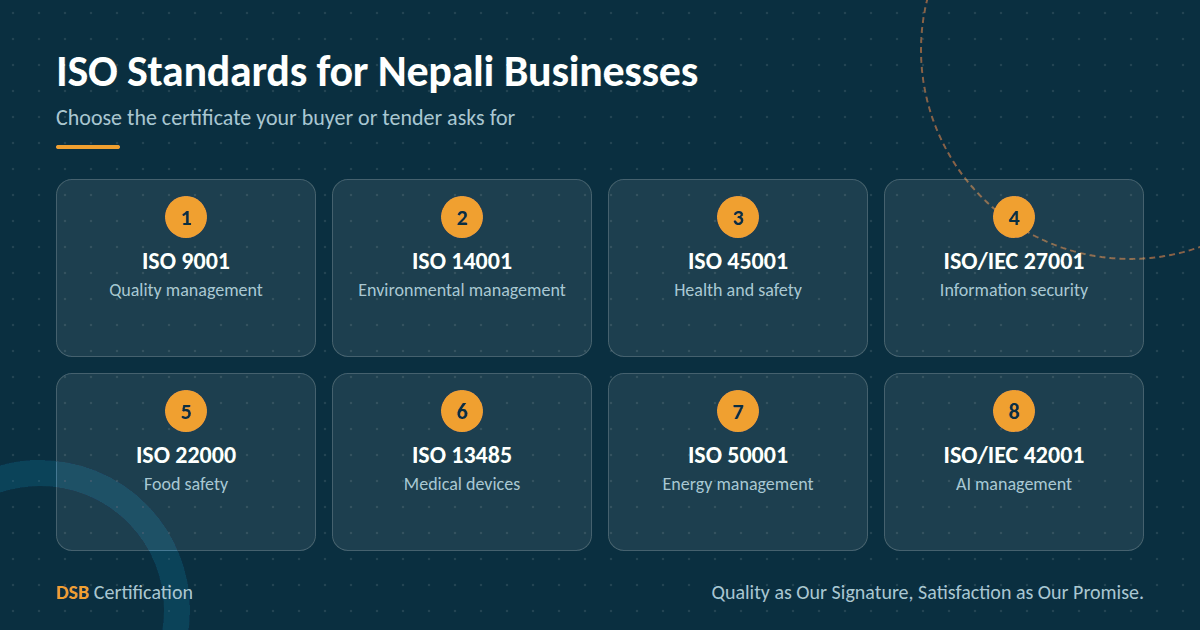
The standards clients ask for most are ISO 9001 certification Nepal exporters and tender bidders need for quality management, ISO 14001 certification for environmental management, ISO 45001 certification for workplace safety, ISO 27001 certification for information security and ISO 22000 for food safety, with ISO 13485, ISO 50001 and CE marking support also available. We offer ISO certification for exporters in Nepal across handicrafts, pashmina, carpets, tea, spices and herbs, and our ISO consultant in Kathmandu team supports ISO certification in Kathmandu, Lalitpur, Bharatpur, Pokhara, Biratnagar and Birgunj on-site or remotely. Most businesses are certified in about 4 to 8 weeks. The ISO certification cost in Nepal depends on your employee count, number of sites, risk level and how many standards you combine, so we give a fixed quote after a short scoping call. Your certificate is valid for three years, with annual surveillance audits in between.
Why ISO Certification Matters for Businesses in Nepal
Nepal's businesses sell into markets that ask for proof, not promises. A buyer who has never visited your factory or office in Kathmandu, Pokhara or Biratnagar has one way to judge whether you'll deliver the same quality in order ten as in order one: a recognised certificate.
Here is where ISO certification in Nepal usually becomes a business requirement rather than a nice-to-have:
- Export buyer onboarding. European and Gulf importers routinely send supplier questionnaires that ask, near the top, "Do you hold ISO 9001?" A blank answer can move you to the bottom of the list, however good your product is.
- Tenders. Many government and private tenders list ISO certification as an eligibility or scoring criterion. Missing it means you can't bid at all.
- Cross-border trade with India. Indian distributors and large buyers often prefer, or require, certified suppliers because it simplifies their own audits.
- Fewer costly mistakes. A working management system catches errors at the process stage, not after a container has been rejected at the border.
Nepal is also preparing for LDC graduation, which may reduce some trade preferences over time. Whatever the timeline turns out to be, competing on documented quality gets more important when you can no longer compete on preferential access alone.
ISO Certification Services We Offer in Nepal
We work with an accredited certification body, so the certificate you receive is recognised by international buyers, not just locally. These are the standards our clients ask for most.
ISO 9001: Quality Management
The most requested certificate worldwide and the one most buyers mean when they say "ISO certified." Our ISO 9001 certification Nepal clients use it to win tenders, pass buyer audits and reduce rework.
ISO 14001: Environmental Management
Increasingly requested by European buyers and by large Nepali manufacturers, cement, steel, brick, paper and processing units in particular, that need to show they control waste, emissions and resource use. ISO 14001 also helps when you deal with environmental regulators, because your records are already organised.
ISO 45001: Occupational Health and Safety
Relevant for factories, construction firms and hydropower contractors where worker safety is a legal and reputational risk.
ISO 27001: Information Security
For IT companies, BPOs and any business handling client data.
ISO 22000 / HACCP: Food Safety
Essential for tea, spice, cardamom, ginger, honey and processed-food exporters.
ISO 13485: Medical Devices
For manufacturers and suppliers in the medical device chain.
ISO 50001: Energy Management
For energy-intensive plants looking to cut power bills.
ISO 42001: AI System Management
For NEW ERA OF AI Give First Mover Advantage.
CE Marking support
For exporters whose products must carry the CE mark to enter the European market.
Integrated management systems
If you need two or three standards, certifying ISO 9001, ISO 14001 and ISO 45001 together typically saves audit days and avoids duplicated documents.
Which ISO Standard Does Your Business Need?
The fastest way to decide is to look at what your buyer, tender or regulator is actually asking for. If the document doesn't say, ask. Choosing the wrong standard is the most expensive mistake in this process.
| Your business | Start with | Why |
|---|---|---|
| Handicraft, pashmina or carpet exporter | ISO 9001 | Buyers want consistent quality and traceable production |
| Tea, spice or food exporter | ISO 22000 (plus ISO 9001) | Importers in the EU and Gulf expect a food safety system |
| Importer or trader bidding for tenders | ISO 9001 | The most common tender eligibility requirement |
| Cement, steel, brick or manufacturing unit | ISO 9001, ISO 14001, ISO 45001 | Quality, environment and worker safety are all audited |
| IT or outsourcing company | ISO 27001 (plus ISO 9001) | Clients ask how you protect their data |
| Medical device supplier | ISO 13485 | Required across the regulated medical supply chain |
Three typical scenarios
The pashmina exporter. A Kathmandu exporter receives a vendor questionnaire from a European retailer that asks for ISO 9001 before any sample order is discussed. With a documented quality system, a gap analysis and an audit, the certificate is in hand within weeks and the questionnaire goes back complete.
The Birgunj importer. A building materials importer wants to bid for a supply tender where ISO 9001 earns points in the evaluation. Certification costs less than a single lost tender, and the same certificate then supports every future bid.
The spice processor. A processor supplying cardamom and ginger to overseas buyers is asked about food safety controls. ISO 22000 gives a structured hazard control system, and the certificate answers the buyer's question in one line.
ISO Certification Process in Nepal, Step by Step
The process looks long on paper but is straightforward when someone guides you through it.
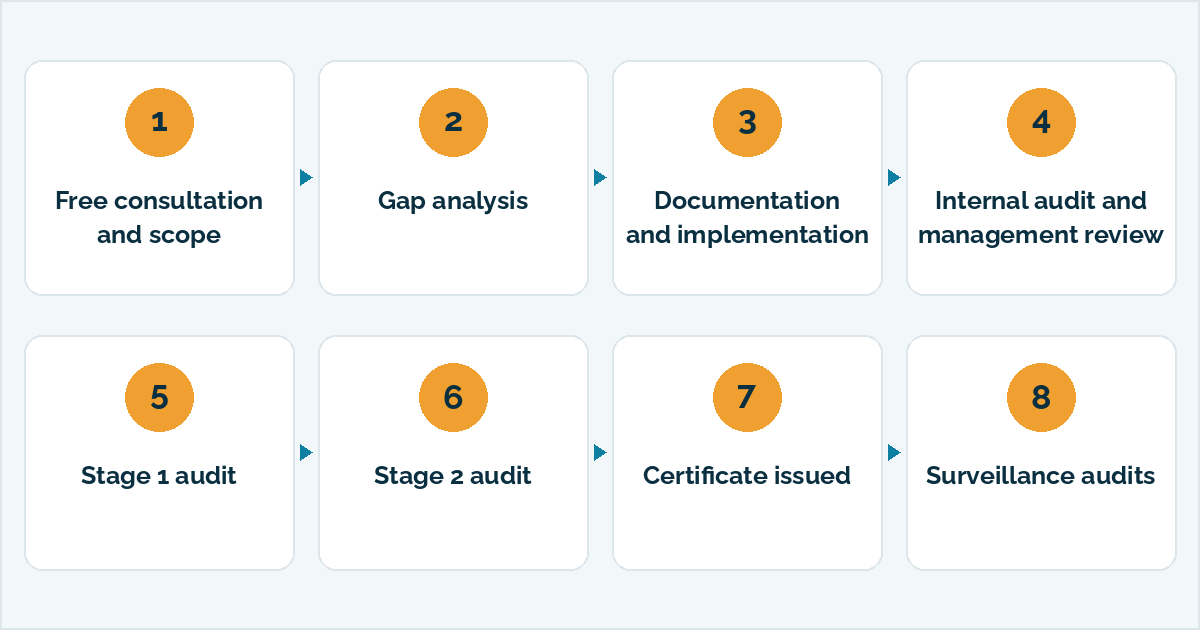
- Free consultation and scope. We learn what you do, where, with how many people and what your buyer requires. This sets the standard, the scope and the audit days.
- Gap analysis. We compare what you already do with what the standard requires. Most businesses are further along than they think.
- Documentation and implementation. We help you create only the procedures and records the standard needs, written in language your team can follow. No 300-page manuals nobody reads.
- Internal audit and management review. A rehearsal that catches weak spots before the real audit.
- Stage 1 audit. The auditor reviews your documentation and readiness.
- Stage 2 audit. The auditor checks that you actually work the way your system says. Audits can be on-site or, where the standard and scope allow, remote.
- Certificate issued. Valid for three years.
- Surveillance audits. Annual check-ins keep the certificate valid, and recertification happens at the end of year three.
Timelines depend on company size and readiness. A small firm with reasonable records can finish in about a month; a multi-site manufacturer may need two to three months.
Do You Need an ISO Consultant in Kathmandu?
You don't legally need a consultant, but most first-time applicants find one worthwhile. An ISO consultant in Kathmandu (or one who works with Kathmandu businesses remotely) helps with three things that are hard to do alone:
- Choosing the right standard and scope the first time.
- Writing documentation that fits how you really work, so audits go smoothly.
- Preparing your staff for the auditor's questions.
A useful test when comparing consultants: ask who will actually do the work, how many audits they've supported in your industry, and whether the certificate comes from an accredited certification body. Be wary of anyone who promises a certificate without an audit. Such a certificate won't be accepted by serious buyers.
Our team supports Kathmandu, Lalitpur and Bharatpur businesses on-site or remotely, and works with companies across Nepal.
Documents and Requirements for ISO Certification
You don't need everything ready on day one, but gathering these early speeds things up:
- Company registration, PAN/VAT details and a short description of products or services.
- An organisation chart and a list of key roles.
- Existing procedures, work instructions, checklists and records (even informal ones).
- Number of employees and sites, which determines audit days.
- Details of legal and regulatory requirements that apply to you (for ISO 14001 and ISO 45001, this includes environmental and safety obligations).
- Your buyer's or tender's exact ISO requirement.
ISO Certification Cost in Nepal: What Affects the Price
Nobody can quote an honest ISO certification cost in Nepal without knowing your business, because the price is driven by audit time, not by the standard's name. These are the factors that move it:
- Number of employees and sites. More people and locations mean more audit days.
- Complexity and risk. A food processor or chemical unit takes more audit time than an office-based trading firm.
- Number of standards. Combining ISO 9001, ISO 14001 and ISO 45001 into one integrated audit is usually cheaper than three separate ones.
- Level of consultant support. Full implementation help costs more than a gap analysis and review.
- Audit format. On-site audits include travel; remote audits (where permitted) can reduce it.
Remember that certification also has ongoing costs: annual surveillance audits and recertification after three years. Ask any provider for a three-year cost view, not just the first-year figure.
Want a number for your business? Send us your employee count, sites and standard, and we'll return a clear free quote within 24 hours.
Why Choose DSB Certification in Nepal
Choosing an DSB Certification in Nepal is mostly about whether the certificate will be trusted when it matters. Here's what we think you should check, and what we offer:
- Accredited certificates. Certificates are issued through a certification body accredited by IAF accreditation body, so international buyers can verify them.
- Experience with exporters and importers. We know what overseas buyers actually ask and prepare you for it.
- Plain-language systems. Documentation your staff will really use.
- Transparent pricing. A clear scope and quote before you commit, with no surprise fees.
- Support after certification. Surveillance audit reminders and help with corrective actions.
Industries We Serve in Nepal
- Manufacturing and industrial units. Cement, steel, plastics, packaging and construction materials: ISO 9001, ISO 14001, ISO 45001.
- Food and agro-processing. Tea, spices, honey, herbs and packaged food: ISO 22000 and ISO 9001.
- Handicrafts, carpets and textiles. ISO 9001 for consistent quality and buyer confidence.
- IT, software and outsourcing. ISO 27001 and ISO 9001.
- Healthcare and medical supply. ISO 13485 and ISO 9001.
- Education and training providers. ISO 9001, and ISO 21001 where relevant.
- Traders, importers and logistics. ISO 9001 for tenders and supplier credibility.
ISO Certification Across Nepal: Kathmandu, Pokhara, Bharatpur and More
We provide ISO certification in Kathmandu, Lalitpur and Bharatpur, and support businesses in Pokhara, Biratnagar, Birgunj, Butwal, Bhairahawa, Hetauda and other industrial areas through on-site and remote audits. If your operations are outside the Kathmandu Valley, tell us where; audit planning, not distance, is the only thing that changes.
Frequently Asked Questions
Is ISO certification mandatory in Nepal?
No, ISO certification is voluntary in general. However, buyers, tenders and some regulated sectors may require it as a condition of doing business, which makes it effectively necessary for many exporters and contractors.
How long does ISO certification take in Nepal?
Most small and mid-sized businesses take about 4 to 8 weeks from the first consultation to certificate, depending on readiness. Larger or multi-site operations may need two to three months.
How much does ISO certification cost in Nepal?
It depends on employee count, sites, risk level, number of standards and consultant support. Because audit time drives the price, we give a fixed quote after a short scoping call rather than a generic figure.
Is a Nepal ISO certificate valid internationally?
Yes, if it is issued by an accredited certification body. Accredited certificates can be verified by overseas buyers, so always check the accreditation before you sign.
What is the difference between ISO certification and the Nepal Standard (NS) mark?
ISO certification shows your management system meets an international standard. The NS mark, issued through Nepal's national standards body, relates to a specific product meeting a Nepal Standard. They solve different problems and some businesses need both.
How long is an ISO certificate valid?
Three years, subject to annual surveillance audits. After three years you go through recertification.
Do you offer remote audits?
Where the standard, risk level and accreditation rules allow, yes. Some audits, especially for higher-risk sites, still need an on-site visit.
Can I get ISO 9001, ISO 14001 and ISO 45001 together?
Yes. An integrated audit combines common elements such as document control and internal audits, which usually saves time and cost compared with separate certifications.
Get Your ISO Certification in Nepal Today
Whether the pressure is a buyer's questionnaire, a tender deadline or your own growth plans, the quickest way forward is a short conversation. Tell us your business, your location and the standard your buyer has asked for, and we'll come back with a clear plan, timeline and quote.